Accidentally I stumbled upon an old research project which I prepared for a course titled Gender, Photography and New Technologies while studying for my Masters at Goldsmiths College, Univ. of London in 1999. It was published by the then uber e-magazine called ZAYAC in Macedonia of which I was a contributor. 11 years on and still highly relevant. “While the science fiction cyborgs are described as strong, powerful, supernatural and artificial human-machines, the phenomenon called online communication has produced new form of disembodied cyborgs. But, this can lead to loosing control over the actual ’self’ and the line between imagination and reality is blurred” says the research.
From Cyber Femme and androids, to Military / Medicine Cyborgs and self-run computers, read my debate on Cyborg in Science Fiction and Cyborg in Social Realm.
* Perhaps I should continue the debate with Cyborg in Nature (after seeing AVATAR last week), so watch this space…
When I first saw the Camangi WebStation appear in folk’s hands I was excited as it looks like a very nicely constructed tablet. It almost looks like a giant iPhone, with solid lines all around. The verdict is still out if it is the sweet tablet it appears to be, but the first review of the WebStation shatters the illusion. Laptop Magazine has one of the tablets in hand, and their review is one of mixed emotions.
By itself, this device is actually pretty cool. It’s got a 7-inch screen, weighs 0.8 pounds, doesn’t tire out the hand or wrist, and is great for surfing the web..
As we mentioned, the device is sluggish, taking a few seconds longer to load apps and Web pages or respond to button presses than we like.
When we watched the included WebStation promo video it didn’t play smoothly, stuttering and hitching noticeably in many places. We weren’t able to test any other videos as only MP4 and 3GP formats are supported and the YouTube app wasn’t included.
It seems that the Camangi is almost there, but that’s often the case with mobile gadgets. Great, if only it did [insert your preference] better. I do think the inability to hit the Android Market for apps is a problem for these web tablets.
Google has introduced many a great application that has withstood the test of time thanks to its easy-to-use interface or profound utilitarian value. Google search is just one among them. There are many others – Maps, Translate, Earth and Docs (an online productivity suite, wow!); the list goes on….
There are many tech terms that have become common parlance as verbs these days. Suppose you want to send a message to your friend. What would you prefer, to ‘SMS’ him or ‘e-mail’ her? If you don’t know what Sixth Sense technology is all about, getting to know more is just an online search away. Just ‘google’ it!
And now, with the kind of research that’s been going on in the Google world, you can now do what’s called ‘visual search’ using your mobile phone. Sci-Fi??? Not really! With Google Goggles, you can ‘just do it’! This article focuses on what could be one of the coolest Google apps we’ve seen….. yet!
Created for the Google’s ingenious Android Operating system, the Goggles application allows cell-phone users to point and click at various objects in the real-world using their phone’s camera and then use the mobile web to instantly search for information on the image. How thoughtful of the folks at Google!
Landmarks:
How often have the tourists among us found ourselves scratching our heads trying to figure out what the name of the magnificent building is that we find yourselves standing in front of. With the Goggles app, scratch no more! Just point your camera phone at the building, click an image and voila, you have relevant information from the web displayed right away, maybe even details of when it was constructed and who the architect was. This could be a blessing for tourists/ travellers.No more typing in words or addresses to map the location and thereby the places of interest around.
Businesses:
Standing on a street on some part of the world, and being able to use live GPS facilities to identify places of interest and businesses nearby is a phenomenal improvement to the tried and trusted GPS tracking many of us are used to. What really amazes me is that this feature does not even require photos to be taken. Just point in the general direction of the street and if the google search/ GPS database already has information on the location, you could see the establishments nearby appear on the scroll-bar at the bottom of the phone’s display window. Just click on any of the text that appears to get more information on the business/ location.
Logos:
Just taking a picture of a logo could give you instant information about the brand associated with it and details of the company as well. How cool is that?
Books:
Shouldn’t judge a book by its cover? Yes, of course. But now you can definitely find out more information about the book, so that you can make a… ahem… more informed judgment. Just click on the cover of the book, and the Goggles app immediately starts a google search and gives you more details on the book you’re looking at.
Wine:
Click on the label of a wine-bottle and there’s a good possibility you’ll find information on the wine at your finger-tips, including the type of wine, how it was made, the year in which it was made and where. As a wine-lover myself, I am biased toward this great feature.
Artwork:
Picture this (no pun intended). you’re looking at an enchanting painting and are drawn in by it’s attention to detail… and you’re wondering – Manet? Monet? Vernet? Start the Goggles app on your phone; point the camera at the image… and ‘click’!
The tool is still in development, and does have limitations as to what can be ‘goggled‘. For example, the application cannot recognise faces, flora, fauna, food, clothes and cars currently. The application only runs on Android devices running OS v1.6 and above.
Here’s an interesting video on how Google developed this tool and where it stands currently, in terms of usage and effectiveness: MSNBC Video
On a closing note, I think that the future is very bright for this tool, and the application of this …well, application knows no bounds. I read on one of the online reviews that a Goggles-user used the app to identify the character displayed on a Pokemon card that was lying on the floor. Imagine what a great impression you could make on your children if you could demonstrate your knowledge on something so important to them. Want to impress friends, relatives or even a potential mate? It’s now easier than ever by appearing more knowledgeable… what does it matter if the knowledge was acquired only a few minutes earlier by simple point-and-click operations?
Google deserves praise for attempting to bridge the divide between the physical and the digital worlds.
After a whirlwind of rumors that Motorola is prepared to give details on how it intends to sell the war in a good headset, not Motorola smartphones like the iPhone 3G pre-S and Palm changer promises to play its own plate.
Thats when Motorola will be more than what would be revealed, according to analysts and reports, information on two new smartphones from Google’s Android operating system.
The open source operating system, Google Android has been marketed for the first time in October of 2008 on T-Mobile G1 phone and then again in August 2009 on the T-Mobile 3G myTouch.
Although details of the new Android phones still speculative power, a spate of reports about the Motorola web have largely supported the integration of social networking with Facebook and Twitter, a new phone her.
Many of the code names have scoffed at the same time with this release. If you’re digging deep, we should all know, are interested schools (QWERTY phone also sometimes written Shuler), Morrison .
Here’s a little short blurb on how to pass information between Activities (I know this is probably documented, but at least for me it always helpful to see small examples in action):
public class A extends Activity {
@Override
public void onCreate(Bundle savedInstanceState) {
// code here
Intent i = new Intent( this, B.class );
i.putExtra( "int", 5);
i.putExtra( "string", "hello" );
startActivity( i );
}
}
And here’s the code for Class B:
public class B extends Activity {
@Override
public void onCreate(Bundle savedInstanceState) {
// code here
Intent i = getIntent();
int number = i.getIntExtra("int", -1);
String str = i.getStringExtra("string");
// number = 5
// str = "hello"
}
}
So basically the idea is you pass the intent to Class B and the intent acts like a standard Map object. For getIntExtra, if the app can’t find the value with key “integer”, then -1 is returned as the default, and for getStringExtra, if the app can’t find the key then null is returned.
The folks at Mint are working on an Android (s goog) version of their software, and I can’t wait. I’ve been using their service to help manage our home finances and investments for nearly two years, and the iPhone app is stellar. Since it’s all but certain that an Android device is in my future, Mint’s efforts (Intuit’s really) are timely. The company estimate for a software launch is by the end of the first quarter, says ZDNet, but the software won’t sacrifice quality for a schedule. That’s important when dealing with something as crucial as people’s financial information. Also in the works is a method for manual transaction entry at the point of purchase, making Mint more like a checkbook register.
The latest version of Mint for iPhone got a big boost when it hit a few months back. Alert notifications arrived, which give me a heads up when a bill is due or when I’m approaching my budget limit in a particular category. Clearly, I’m not doing too well from a budgetary standpoint this month — I’m over on three categories! And aside from basic tracking and reporting on all expense activities, the latest version allows for modification of transactions on the iPhone.
While that might not sound like much, it comes in handy for check transactions in particular. I often see transactions listed as “Check 123″ for example — that doesn’t tell me who the check was made out to, nor does it specify what expense category the amount is associated to. With support for manual modification, I can make the appropriate changes right on my phone and have them sync back up to my Mint account on the web. Not everyone wants to trust their data to Mint, but for me, it’s a must-have app on my handset.
Android developers are having office hours on IRC now. I’m very thankful that they’re willing to provide help, and I hope they use the questions and answers to improve documentation so they’ll have fewer questions to answer in the long run (and fewer frustrated developers wondering what’s going on), but – I wasn’t impressed just yet. I was on channel for the time yesterday, and asked three questions via the moderation tool they’re using, which other users seemed to like. They did answer one question on channel – to say that what I want to do isn’t really possible yet. Didn’t address the others or many questions at all. Looks like the questions to the earlier session didn’t get answers yet – but there were answers to the questions from a week ago. So maybe they’ll get to it, but if you have to wait a week for answers, what’s the point of office hours? Well, maybe the holidays aren’t the best time – I’ll reserve judgment. And frankly, any kind of responsiveness is appreciated. And if I can get answers eventually, I have answers for my problems and new material for the android blog
Know what I figured out today? Resource IDs don’t need to be globally unique. You just can’t inflate the same resource ID from different places in the same context. The R generator doesn’t seem to care that two things generate the same ID. Phew! I was naming my IDs with little prefixes based on the filename so as to keep them all unique globally; it’s not pretty. That was an assumption on my part, but I never saw anything to contradict it… maybe it’s time to read those dev docs more thoroughly!
Outstanding questions/problems:
Can I arrange my layout resources into subdirectories? I’m getting to have quite a few. Will have to try this and see if it causes problems – might mess up internationalization, orientation-specific layouts, etc?
I know I’m mismanaging my DB handles and cursors somehow – need to look into proper practices there.
I haven’t really dealt with lifecycle stuff properly. This shouldn’t be too hard, just need to actually do it. This is one of those areas where formal tests would be most helpful, as it’s hard to manually test the transitions properly.
I have a spinner that I need to use and fill from several different components – at least two Activity classes and one Dialog. Looking for a way to reuse the same code and layouts; not clear just yet. But along the way I came across this forum post which I’ll have to look at next time I’m trying to build a custom view.
Also I have a custom dialog that only enables the “OK” button if a text editor has text in it, and wanted to generalize that. The problem is with how much stuff you have to specify to wire it all together. I think what I really want is an AlertDialog with a text field and some extra magic to enable/disable the positive button, but to get all that working I’d pretty much need to subclass AlertDialog.Builder too, and not sure if that’s worth the pain. But perhaps worth a try. You’d think this would be a standard feature, though… a dialog that validates input before enabling the buttons to be pushed.
Next problem: I have a ListView and I want to have a spinner at the top and a text entry box at the bottom. Putting this inside a ScrollView does not work, I get this:
How do I get the ListView to stay fully expanded? I found several forum posts warning against using a ListView within a ScrollView, so that’s out. The main commentator on this seems to be Romain Guy, who’s obviously very knowledgeable, but he’s also really lousy at adequately answering questions. His blog entries on Android are pretty sparse. I still wanna read them but man is it frustrating reading his half-answers in forums.
Looking for ListView attrs… Well, the ListView reference docs say that you can add header and footer elements; any way to do that in XML? Does not look that way. I’ll try it in code first. When I first used ListView, I naively thought that you should place the “empty” item inside the ListView element in the XML. Certainly makes more sense than putting it after, don’t you think? I mean, at least conceptually it’s part of the view; but the designers thought otherwise. Actually, at this point it looks like anything you place after the ListView element is used for the empty view. Anyway, I put a header element before and footer element after in the file, and added them to the ListView in code like so:
getListView().addHeaderView(findViewById(R.id.il_list_spinner)); getListView().addFooterView(findViewById(R.id.il_new_item)); This causes a lovely runtime exception, which basically tells you nothing about what went wrong:
java.lang.RuntimeException: Unable to start activity ComponentInfo{net.sosiouxme.WhenDidI/net.sosiouxme.WhenDidI.activity.ItemList}: java.lang.ClassCastException: android.widget.LinearLayout$LayoutParams at android.app.ActivityThread.performLaunchActivity(ActivityThread.java:2401) at android.app.ActivityThread.handleLaunchActivity(ActivityThread.java:2417) [...] Caused by: java.lang.ClassCastException: android.widget.LinearLayout$LayoutParams at android.widget.ListView.clearRecycledState(ListView.java:489) at android.widget.ListView.resetList(ListView.java:475) at android.widget.ListView.setAdapter(ListView.java:417) [...]
Pretty helpful eh? Yeah. Might as well just say “dude… something’s wrong with your layout.” I’m guessing it doesn’t like me reusing view elements of the current context as elements of the ListView. Or maybe it’s related to the “poorly documented” bit mentioned in this thread (this would be more helpful with a pointer to the back story). And now I can’t figure out how to debug down into platform code – is there some way to attach source code so the debugger can look at it? Can’t seem to find anything on that in a search either. Good grief, this stuff makes me feel like an idiot!
Here’s some articles on customizing ListView to read later. Not germaine to my current purpose AFAICS, unfortunately.
As an aside – the Eclipse tool for building XML layout resources, while helpful, is really annoying. Chief among the annoyances is when you’re trying to scroll through the list of properties for a tag – each attribute has a little blurb about what it’s for, which conveniently pops up to cover what you’re trying to look at every time you pause! And if you’re really lucky, it pops up right under the mouse, keeping you from scrolling. You know, what I need is not automatic popups – I’d rather have a mouse button specifically to give me info about what I’m looking at. The middle mouse button would probably be perfect since I don’t think Eclipse does anything else with it. Looking for preferences I can set to disable or control the hover, but even with all hovers disabled this still pops up. Wonder if it would do me any good to try to fix ADT?
And why is it that adb keeps losing track of its emulators? Kill the server and restart it, and it finds the emulator again… only to lose it again quickly. Bah!
Last month we asked all the carriers and handset makers, What is the Android 2.0 release date for first generation phones? We didn’t get a lot of clear cut answers at the time, but several carriers have now come forward and stated their plans for Android 2.x updates.
There are currently seven Android phones in the United States running Android 1.x, so we are going to break the list down by carrier and see which are getting upgraded.
Sprint
Last time we checked with Sprint, they told us they were currently working through their options with their manufacturing partners. It appears they got everything sorted out because Sprint tweeted that both of their Android phones will be getting Android 2.1. They provided a release date of first half 2010 (my guess is Q2 2010), but at least they confirmed their intentions.
HTC Hero – Yes, 1H 2010
Samsung Moment – Yes, 1H 2010
We are still waiting to find out how these major updates will be rolled out. Sprint initially indicated there would be wired updates, but that is subject to change.
T-Mobile
For most of 2009, we have known T-Mobile to provide regular updates to their Android handsets. After the last Android 1.6 rollout, we have been left wondering if we would receive anymore. T-Mobile has told us they were coordinating with Google to deliver Android 2.0, but they have not specified which devices may receive it.
We recently saw HTC go on record and tell us no updates were planned for their Rogers Wireless Dream and Magic phones, so it would not be surprising to see a similar announcement for T-Mobile. However, both the Dream (G1) and Magic (MT3G) also serve as official Android Developer Phones, so we hope Google will continue to support them.
Things are not looking too good for the Motorola CLIQ. It recently received an update, but it focused on bug fixes and left the firmware at Android 1.5. The last time we asked Motorola about Android 2.0 coming to the CLIQ, they basically said to get a Droid to experience the latest version of Android. We also reported on a rumor that the CLIQ could be stuck on Android 1.x and have seen nothing to dispute that yet.
Samsung Behold II owners are the only T-Mobile customers who have something to look forward to right now. Their device shipped with Android 1.5, but Samsung said Android 2.0 would be made available “when it arrives”. The announcement came from a YouTube video, but it is better than nothing. Since Samsung is also updating their Sprint Moment, I would say things look good for the Behold II.
HTC G1 – Unknown
HTC myTouch 3G – Unknown
Motorola CLIQ – Unknown
Samsung Behold II – Yes, “when it arrives”
Hopefully, T-Mobile will give us an answer on their other phones soon (even if the answer is no).
Verizon Wireless
Verizon was the carrier that launched the first Android 2.0 phone (Droid), but they also have the Android 1.5 powered HTC Droid Eris. Last time we asked Verizon about updates, they could not provide any additional information.
HTC told us Verizon had to request an update and it looks like that is what happened after customers spoke out. Information Week reported that a Verizon rep confirmed an Android 2.0 update for the HTC Droid Eris sometime in Q1 2010.
HTC Droid Eris – Yes, Q1 2010
It was not exactly an official press release, but we will take it.
So I was reading around and found something to write about. Yay. My buddy asked me if there were any new Android phones coming out for Verizon Wireless. I said I didn’t know of any coming out but just today I found out that there will be a new handset coming out: HTC Incredible. What does this baby include? No one knows as the code name was the only thing leaked. The only thing I can hope for is a bigger screen than the Hero/Eris and hopefully more manly lookin’- eh? Eh?. QWERTY keyboard would sound hawt and kicking up the camera up to 8MP wouldn’t be bad either. No matter wut you may want the phone to be, it may most likely run Android 2.1. That’s all I really have for this. More to come as info becomes available.
In other Android news, the interwebz have EXPLODED with the new Google Phone Nexus pics. There are a few lucky bastards out there playing around with these phones but only 1 with the balls to leak out some visuals. The phone looks pretty cool with its cool touchscreen and cool 4 buttons n stuff and it looks like it’s running android 2.1 as the OS looks identical to the recent leaked one as shown in this vid .
2.1 seems to be the latest and greatest and now that it’s out, we’ll see how the early go-getters react. 2 extra homescreens is a plus but a-GPS isn’t. I’ll probably update sometime this weekend and post a full review. Wut about you? If you already did, then what are your thoughts? Super fast, eh?
Dear HTP-People,
I recently bought (for the first time, I used to use used ones) my first mobile phone, the HTC Hero.
My purchase was made with the decision, to buy the best Android phone out there. And thus far I am quite satisfied with it.
Unfortunately, the phone’s software hasn’t been updated for three month. Two major upgrades for the Android operating system have been made by the Android community and Google Inc. in that time, and HTC has skipped the first one and didn’t even bother to acknowledge the second one.
I’d be happy to buy another HTC phone in the nearer future, but for that to happen I have to be convinced by HTC’s product commitment. That includes regular updates for hardware, also for older hardware. The responsibility for a product does not end at its sale.
I would eagerly buy another Android based HTC phone. But until I see a more committed product support by HTC, I cannot consider HTC Phones as an option.
Last year for Christmas I was given a brand new g1. It was my first smartphone and I wasn’t sure the ins and outs of a smartphone so I started researching. I started joining forums and reading blogs and slowly but surely I started to see. Not only was this new, sort of clunky looking phone nothing short of a pocket computer, but it was also a key. It was the key into the world of android and boy what a world it has become.
I remember early on just browsing the forums trying to see what folks are talking about. They would say “my phone can do this” or “my phone can do that” or “the battery sucks” or “it’s gonna be an iphone killa!”. All of those things intrigued me but I was still learning about apps and open source and all of the other caveats of this little green robot. I started to look into what google had to offer and realized it could do more than just search and it was all hyper-connected to my phone. I slowly and more confidently started to see the potential this little giant had. So I start posting in forums and asking questions and finding out the little intricacies of my g1 and I was on my way.
A few months later, completely comfortable with what I have, I start reading about rooting. I say to myself “Self. What’s that all about? Who really needs to do that?” The more I read the more it pulls me in and then one night around 11pm with my palms sweating and heart racing my phone gets rooted and another part of the android world opens up to me. Not only is the phone a key to another world, but it is your pass to meet new people and be a part of a wonderful communtiy that is built on building new relationships, pushing the platform forward and helping out a fellow droid. This is what really sold me on android. I think the phones are great, the OS is coming along beautifully, but it’s the people that make android what it is today. I would like to say “thanks” to those that have driven the development, started the websites, moderated the forums, answered questions, lent a hand when needed and have helped people see that you don’t have to be scared to blaze your own trail. Like field of dreams, if you build it they will come and google built it and we were there for the flocking.
I truly am impressed with how far android has come in a year and look forward to being a part of it’s continued growth and success. Thanks google for everything, thank you to all the people who have helped me out so far and I appreciate the communtiy as a whole. Y’all are great! Have a wonderful holiday season and bring on the nexus one!
Url: http://www.myxer.com/
Launch Partners Include ReverbNation, Kedar Entertainment, Amie Street, SonicBids, OurStage, INgrooves,The Orchard, Audiolife and SellaBand
Deerfield Beach, FL (December 15, 2009) – Myxer, committed to connecting artists and fans through mobile, today announced broad expansion into the artist services realm with significant new offerings designed for enhanced mobile engagement and promotional opportunities, as well as several key strategic partnerships with music industry notables.
To complement the company’s music marketing offerings, Myxer is today launching MobileStage, the most comprehensive mobile marketing suite available to the music industry– featuring a music application distribution service for iPhone, BlackBerry and Android applications.
Myxer’s MobileStage offers the following tools to all artists:
- Free, enhanced mobile websites
- Mobile fanlist management and messaging
- Advanced data analytics
- Promotional initiatives for artists based on location and touring routes
- And, for independent artists, A&R opportunities with some of the industry’s top music management professionals
As part of Myxer’s application distribution service, the company will promote artist apps to its user base of nearly 30 million customers. On behalf of INgrooves, a MobileStage launch partner, Myxer will feature iPhone apps from electronic music heavyweights, The Crystal Method and revered rock “Mockumentary” subjects, Spinal Tap.
Myxer’s MobileStage is an evolution of the company’s core offerings, providing a one-stop shop for artists to use mobile music technology and tools to connect with fans in more personalized and engaging ways.
Brandon Hance, CEO of Audiolife, added: “Myxer’s size, features, and scalable platform made them the only logical choice as we looked for a mobile partner to power our artist services. They are the clear leaders in mobile content delivery.”
“Myxer currently works with more than 100,000 artists, from the fiercely independent to some of the industry’s biggest names, delivering customizable and feature-rich mobile content to help these artists connect with their fans in powerful new ways. For content providers and consumers, Myxer’s mobile platform enables radically simple and rapid delivery of content. Named a Top Wireless Company in 2009 by FierceWireless, Best Music Service at the 2008 Mobile Entertainment Forum, and Best Consumer Messaging Application at the Global Messaging Awards 2008–Myxer’s unique solutions continue to capture attention, both domestically and abroad. To learn more as well as see a sampling of brands that have used Myxer to power their campaigns, please go todemo.myxer.com.
Myxer, MobileStage, and the Myxer logo are trademarks of Myxer Inc.
SAN FRANCISCO — Two titans of the tech world, Google and Apple, may soon be engaged in hand-to-hand combat. Or, more precisely, handset-to-handset combat.
Google plans to begin selling its own smartphone early next year, company employees say, a move that could challenge Apple’s leadership in one of the fastest-growing and most important technologies in decades.
Google’s new touch-screen Android phone, which it began giving to many employees to test last week, could also shake up the fundamentals of the cellphone market in the United States, where most phones work only on the networks of the wireless carriers that sold them.
The company, using
the power of its brand, plans to market and sell the new phone directly to consumers over the Internet, and buyers would be able to sign up for service from any compatible provider, the employees say.
The introduction of a Google phone — manufactured to its hardware and software specifications by an Asian maker of handsets — would be an important and risky departure for Google. Until now, it has made software to power cellphones that are built and marketed by partners, and it has largely avoided selling hardware.
The apparent shift underscores the fact that mobile phones are quickly becoming the biggest technology battleground of the future, as consumers increasingly rely on their phones to browse the Internet and perform other computing tasks.
It also indicates Google’s determination to make its mark on yet another industry, as it has done previously in advertising, books and online videos.
But analysts say it is not clear that Google’s success on the Internet will carry over into the design, marketing and distribution of hardware. Many companies have tried to make similar shifts and stumbled. Microsoft turned the Xbox into a hit, but when it pushed aside its partners in the music-player business in favor of its own Zune, it failed to gain traction against Apple and its iPods.
The phone’s success could also depend on how Google chooses to price it. Most Americans buy phones that are subsidized by wireless carriers, which recoup that cost by locking customers into contracts. IPhones that cost consumers $199 actually cost AT&T about $550, analysts say.
Katie Watson, a Google spokeswoman, declined to comment on the company’s plans. She referred reporters to a blog post published Saturday in which Google said that the new device was a “mobile lab” that would let employees test out new technologies.
Google employees who spoke on the condition of anonymity because plans for the phone were supposed to be confidential said that the device, manufactured by the Taiwanese company HTC, was thinner than Apple’s iPhone, with a slightly larger touch screen. It could be available as early as January, they said.
Employees say the phone will be sold unlocked, meaning that buyers will be able to choose a service provider, and will be based on G.S.M. technology, which is used by AT&T and T-Mobile in the United States and by most other carriers around the world. It is named Nexus One, according to various reports and to digital traces that the phones have been leaving on Web sites.
Google had long insisted that it was not interested in building and selling phones, saying it preferred to rely on hardware partners and wireless carriers to market a wide variety of phones powered by Android, the operating system that it offers free.
In October, Andy Rubin, vice president of engineering for Android at Google, scoffed at the idea that the company would “compete with its customers” by releasing its own phone, according to the technology news service CNet.
Analysts say that the apparent shift signals a recognition by the company’s executives that Google needs to take more control of its destiny in the wireless world.
“They perceive mobile as the next major opportunity,” said Jeffrey Lindsay, an analyst at Sanford C. Bernstein. “It is too big a risk to drive the strategy through their partners. They want more say and more control.”
In addition, analysts say that the iPhone, despite prominently featuring some Google services, makes the company nervous.
“They don’t want to have access to Google being controlled or influenced by one player like Apple,” said Ben Schachter, an analyst with Broadpoint AmTech, a research firm.
Google wants to get more people using Web-friendly phones in part because it depends on the growth of search advertising, which is slowing on PCs. On cellphones, however, use of Google’s mobile search engine grew 30 percent in six months this year, Mr. Schachter said. “That’s huge, and a majority of that growth is coming from the iPhone,” he said. “When that happens, Apple has a lot of power over influencing users’ behavior.”
Until recently, Google and Apple were considered close allies with a common enemy: Microsoft. They shared two board members, Eric E. Schmidt, the chairman and chief executive of Google, and Arthur Levinson, the former chief executive of Genentech.
- Supposedly it will be available through Google for a mere $199.
- This may or may not be the subsidized price after a contract with T-mobile.
- A $100 rebate will be available for users with old but active Google accounts.
- Sales begin Jan 5.
For those of you who saw my hasty little tweet, this will be annoying and repetitive.
But I’m posting it anyway because it’s potentially exciting. Google is supposedly partnering with hardware gods HTC to bring their own in-house handset design to market with a fresh batch of Android OS.
Make the jump for details.
As they reported on their Mobile Blog yesterday, they recently handed out a large amount of testing units to employees, essentially initiating internal beta testing:
We recently came up with the concept of a mobile lab, which is a device that combines innovative hardware from a partner with software that runs on Android to experiment with new mobile features and capabilities, and we shared this device with Google employees across the globe. This means they get to test out a new technology and help improve it. – Official Google Mobile Blog
The Engadget story linked at the end of this post rocks a photo of the GSM handset, rumored to sport an OLED screen and a trackball. The word seems to be an early 2010 release. There has been talk that a Google-branded handset would tightly integrate Google Voice, which has been restricted by carriers fearful that its features will outshine their own.
The carriers (AT&T, Verizon, Sprint, and T-Mobile are the big players State-side) are right to fear, too. I use Google Voice as my primary voicemail client and to route calls to personal and work phones, as well as read voicemail transcriptions via email and have SMS conversations on the web. Since Google Voice is web-based, even when I’m out of Sprint coverage, I can get full SMS messages and notifications of missed calls and entire new voicemails over wifi.
For now, we’ll just have to wait and see. But I hope Google does this right. Hardware control is their new thing, with Chrome OS also expected to be limited to Google-approved hardware, including a requirement that all devices sold with it run only SSD, or solid-state, hard drives. They’re getting their feet wet in waters Apple has been ruling for a long time. Complete control from hardware design to OS is the ultimate mode of expression for any tech company, and Google can’t afford to screw that up.
Here’s to hoping for a kickass handset from them. And soon.
“Google Phone / Nexus One makes first Twitter appearance?” – Via Engadget
Trying to figure out how best to import Android projects into eclipse, particularly from a version control checkout. I’ve had the same trouble with trying to use samples downloaded from book/tutorial sites. What I’m trying to do:
I want to locate the project in my eclipse workspace.
I don’t want eclipse-specific files in version control – those seem to cause problems when moving between different eclipse installations. Or, in the case of downloaded examples, these files aren’t provided.
Use git; other VCSs have Eclipse plugins to simplify this – git does too, but it seemed half-baked and I shouldn’t have to use a plugin to do this.
Problems:
If I check out the project outside my workspace, and then try to create a project in eclipse using that as source, eclipse does not move or copy it into the workspace; it uses the original location (which makes sense)
If I check out the project within my workspace, and then try to create a project using it as source, eclipse refuses because of the location.
If I use File -> Import -> General -> Existing projects into workspace, eclipse expects to see its project descriptors (that I deliberately excluded with .gitignore) and refuses the import.
No other options seem appropriate to doing this
Here’s one way to do it:
Check out the project somewhere.
Use the “create project” dialog to create an Android project using this location as source. This adds the requisite eclipse project descriptor files.
Close the project and delete it (leaving the files in place of course).
Move the project directory into the eclipse workspace.
Use File -> Import -> General -> Existing projects to import the project directory – since the project files are there now, this works fine.
I wonder if I’m just nutty leaving the eclipse project files out of the checked-in version. But they just don’t seem to belong there, neh?
If, like me, you’re waiting for Android 2.0 or 2.1 to hit your HTC Hero, you may be interested in this tweet from HTC, posted yesterday, 11 December:
I’m not with Sprint. In fact I’m in the UK with T-Mobile, but I’m hoping the rollout will be pretty much at the same time, across all networks.
Earlier reports (like this one from Phandroid) had said the rollout would be sometime in the first half of 2010, which could be a longer wait. Let’s hope they’re wrong.
Whatever the date, at least it looks like it will happen. Some commentators had suggested that the retro-update of Android 1.6 with Google Mapping updates like those of 2.0 may leave some devices at 1.5 and 1.6 indefinitely. There was also talk of rollout before Christmas but, on the positive side, the delay into 2010 must be good for the feature list of the update. Looking forward to seeing HTC Sense running on Eclair.
Have you heard any more news on this? Leave a comment.
According to Verizon and BGR, random HTC ERIS users should have received an update right around midnight last night (or is that this morning?).
The new ROM version is 1.16.605.1 and the radio version is 2.32.40.11.09. Like all OTA updates it will be distributed to some first and then the majority.
I happen to be one of them who still haven’t received OTA update yet. But don’t worry if you haven’t you soon will receive the update. Like all OTA updates it will be distributed to some first and then the majority of us later. No one is left behind. I know this is a great news for HTC Droid Eris users.
Here’s a brief list of some of the fixes:
While on a call and the device is in screensaver mode, pressing the
End key now takes the device out of screensaver mode, and a second press will end the call.
On-call mute and speakerphone icon functionality is enhanced.
Upgraded functionality after activation eliminates the delay users were experiencing in receiving their first call.
Device now switches effectively from 1x mode to 3G.
Device no longer requires users to reselect a default email after power-cycling.
SMS and MMS messaging delivery is improved.
Eighty-character MMS/SMS message subject lines are now allowed
Improved picture messaging functionality allows messages from LG phones to be opened.
More info can be found here Verizon Wireless on how to check for the OTA update.
A little over a year after releasing the HTC Dream/T-Mobile G1, T-Mobile recently introduced its fourth Android device, the Samsung T939 (Behold II), and provided me with a review unit
The Behold II follows in the footsteps of the T929 (Memoir) and the T919 (Behold). Like its predecessors, it’s a nice touchscreen phone with a good camera. Unlike its predecessors, it’s a smartphone running Android, with an OLED display, WiFi, and standard audio & USB connectors!
It features the same form factor as the the HTC Magic/T-Mobile myTouch3G (no physical keyboard), but deviates from standard Android with TouchWiz, yet another custom user interface similar to BLUR on the Motorola CLIQ, and Sense on the HTC Hero…
Frankly, this user interface fragmentation is a shame. Standard Android is fine – just ask the phenomenal Motorola Droid. Why bother with a custom look and feel?
I’ll be testing the Behold II on my primary line for a few days, so stay tuned for more thoughts and experiences. In the meantime, check out my pictures and video:
2Mbps on a 3G phone.. , on a device much more portable than a personal computer. India is in for a spew of Internet Services, from VOIP applications to web applications based on different web services. The browser is going to be on a handheld device for a market of 1 billion people (The worlds population is 6 billion, i.e. 1 in 6 people in the world is Indian). Today our internet penetration is only 81 million users (7% of Total Population).. I’m anxious to see the numbers climb after the 3G Auction.
It will be interesting to see the types of applications which will be delivered once these services are available. All these applications are going to built on a range of mobile platforms which will be available – Android, Iphone, Windows Mobile and others (mostly based on linux, including Maemo).
Q1 2010 will start a new revolution for Mobile Value Added Services. Most of the phone manufacturers have already started integrating social media platforms like Facebook and Twitter on their phones. Since these sites have a large user base, their Open API (Facebook Connect etc) will enable an individual to integrate these platforms into their daily lives. From event invitations to service requests (like looking for a local electrician, carpenter etc), everyone will have access to a market which was previously untapped due to physical boundaries. It will be awesome to see how many new ideas come out of micro communities which will get formed with an explosion of social media.
However, going by the speed of execution of our government, I think they are still delaying the auction to enable BSNL in grabbing the initial 3G subscribers.
Here’s an interview with Atul Chitnis on NDTV, about the future of Mobile Phones.
two big announcements came out of the android world today:
1) Google Goggles: This takes web search to the next level with the ability to search with the use of images! in other words: snapping your picture = getting the information. There is a lot of techno-dazzle that goes into explaining how it works, but from what I read, it breaks down the image into signatures that google can recognize. VERY cool. Here is a link to “A Hands-On Tour: Google Goggles”. It looks as if this will be an amazing tool and a great mobile app.
2) Yelp comes to Android: This is pretty self explanatory, but Yelp (one of the largest restaurant, shop,…everything guide) has come to the Android phone. I wont go into the deets, but for more information click here.
I still haven’t found a convincing reason to switch from my Iphone to Android…especially when it has been announced that Google Goggles will soon be available on multiple platforms including the Iphone.
Looking back at my 08 review and predictions for 09, with the exception of social media talk and promise everywhere, not much has changed this year, same players are still in the game and still leading the charge, but with some new products. There are of course new trends popping up daily, but until I can distinguish them based on value, I won’t spend much time on them. So – some of the names making the news last year:
Twitter is still growing strong, to my surprise – I thought it would have flattened by now as the new cool thing would show up for new media gurus to jump on. Also, the mainstream always lags behind pioneers by couple of years. That explains why Facebook is seeing biggest growth this year (2 years after it exploded in Toronto and about a year after I stopped using it on a daily basis), despite lack of any new groundbreaking features except for Facebook Connect. And while Facebook will continue to grow and be part of every household, like email, my jury on Twitter is still out , despite the fact that you cannot engage into conversation about Internet or media without the mention of it. I am still not convinced – I may be wrong but sometimes taking bold predictions and being dead wrong is also fun. Social Media Everything… I’ll dedicate one line to it, because there are some good things and lot of crap and it’s a separate topic anyways.
Cloud computing continued to grow this year, although the mainstream penetration and adoption is slower than expected. Azure, Amazon and Rackspace have added features (Google Apps has been quiet this year), and cloud based productivity apps were growing as expected but it will be years before businesses start relying on cloud for their core business infrastructure.
Apple – continued to deliver stylish products, but no revolutionary things this year, iPhone is a hard act to follow, unless next year they finally release device I’ve been waiting for over a year now (see last year’s post) – iPad
Microsoft – finally has a decent OS – Win7, active cloud development Azure and new versions of Office, SharePoint and .NET 4 in the works, slated for next year. None of these should be reason for celebration as they are existing MS revenue sources and won’t take MS into the next decade as a leader. But MS did manage to make big splash in the news with its new promising search engine:
Bing made a little scare in the Google world this year as it was, to everyone’s surprise, actually decent product. This immediately started talks about challenge to Google etc. I think they are still light years behind in terms of mind share and the know how (not so technologically, but in the knowledge you constantly acquire and evolve by serving 70% of worlds searches). But with acquisition of Yahoo search, Bing will gain more of the market share and the insight into the large volume search data, that will potentially help them improve the engine further. All of this is good, since it will force Google to innovate again (last year I compared them to IE6 – not having any serious competition, their search innovation almost stopped). This is particularly useful, since last year’s promising search technologies, like semantic search, failed to make any mayor impact. Google – almost always warrants a post of its own, but I’ll squeeze couple of thoughts in a paragraph:
Active and innovating, as usual, providing mix of good service improvements (Google Docs and Google Sites have improved greatly and will become significant player in corporate arena soon) and a couple of not so great starts, that nevertheless received raves from tech trend followers and guru wannabes, just because they came out of Google:
Chrome OS – I love Chrome Browser and use it all the time. And I use cloud service for everything good enough for my needs, not by comparing them feature by feature with desktop products. But I will move to the cloud when the services are ready, not when the browser/os limits my other choices. Linux is free and has a free browser that can access all features that Chrome OS can, yet consumers didnt flock to it, because they still need the polish/responsiveness offered by commercial OS-es – Win7 and Mac OSX. When web apps catch up, people will move to the cloud and the browser, with or without Chrome OS. Stripped down Linux limited with single browser will certainly not be the driver.
Google Wave – something is wrong when many people desperately ask questions like “Tell me why this awesome new Google product is so awesome. I am obviously stupid, since I don’t get it’s usefulness and greatness and how it is making my life better”. Emperor’s new clothes, someone?
This is all I can think of in terms of technology in 09 – maybe I was too focused and immersed in my current job – (building organization and the product around our hosted CMS product for large media companies – http://www.topscms.com), and maybe I missed some things. But based on the above, I’d have to say that Twitter was the clear winner in terms of mind share and activity around it as well as based on the influence it’s making not only to other technologies but media in general. Contrary to my predictions (for now), but I have to acknowledge the facts
My mobile phone problems persist. I want an iPhone but I don’t want AT&T. Fortunately there appears to be a light at the end of this tunnel. Unfortunaetly my faith in Apple has been rocked and my eyes are turning to a new champion of the consumer experience…the big, bad, Google.
Despite the latest Droid advertisement belittling the iPhone to a “pretty porcelain princess” figurine, calling its own device a robot that “does”, the truth is that the iPhone does too. AT&T doesn’t. Which begs the question: for a company so hell bent on creating the best user experience possible why now has it chosen to forgo these principles for the sake of control? AT&T is truly the worst.
The Droid is a good phone. The iPhone is a great phone and it’s possible the Google Phone – reportedly being released by Gizmodo and every other tech blog online – will be great too.
Apple has created an incredible ecosystem with Mobile Me. I am able to keep my address book, calendar and files on my computer synced together with my non existant iPhone.
But alas I do not have an iPhone. I have a Blackberry Tour, which by all accounts is a decent phone. Sure, Blackberry Messenger satisfies my inner stalker with “R’s” and “D’s” for read/delivered messages. But decent doesn’t cut it. And the Tour is really my stalemate phone because I have no moves. Google Sync has since come out replicating all the wonderful features of Mobile Me, sans the $99 fee. Which has me taking a notice.
But lets get back to the iPhone and the expectations that Apple has created for itself. They pride themselves on the user’s experience. Microsoft writes its operating system (haphazardly) for dozens of different computer manufactures and it shows. Apple creates its own operating system for its own computers- this too shows. The experience between a Mac and PC do not compare.
Apple revolutionized the way we interact with music with the iconic iPod + iTunes. As a company Apple has moved methodically with great regard to the user experience in every instance except the iPhone. The quality of the service provider (in this case AT&T) has a massive impact on the user experience and the carrier partnership should be scrutinized just as heavily as the number of clicks it takes to get from one menu to the next.
A chain truly is as strong as its weakest link and for whatever reason AT&T is the rotting link on this chain that Apple has bound to the iPhone. So while I appreciate what Apple has done for me, it seems to have side stepped with respect to the iPhone.
I’m now looking for Google to innovate. I have hopes for the Google Phone. The sad thing is the phone my heart..err thumbs yearn for (iPhone) is right in front of me. So while the iPhone is screwing around with that crap carrier I’ve got my eyes open for something better. Maybe Apple will get it’s act together before I lose interest. Maybe not.
Ask The Hoff is now available in the Android Market! It’s our first application for Android handsets (and our second app release in as many days, following on from Instant Turin), and is available to buy from today.
While we’ve been intending to begin Android development for some time, the success we’ve had with Ask The Hoff spurred us into action. We worked with North East developer Alex Reid to port the application from iPhone to Android; the process was entirely quick and painless – we only decided to go ahead last Friday – and Alex has done a first class job. He comes highly recommended and we certainly hope to work with Alex in the future on new Android projects.
That’s not the end of our Hoff-related news; a stripped down version of the app – Ask The Hoff Lite – will be available for free next week in the iTunes App Store. P
Updated all my links *** This is cyan 4.2.5 with Android 2.0 theme has roots on my G1 = D Since it is a stable 1.6 Donut ROM, everything works and then some. You have 5 screens, Bluetooth file transfers, wireless connectivity, landscape mode on the Home screen, everything. The reason I posted this vid is cuz it has a lot of confusion as to get as cyan (a donut-ROM * NOT * Hero) and was running on the G1. All this was done, was suggested as a cyan …
Early last week, startup MiKandi launched a 3rd-party app store for Android phones which will allow any developer to sell adult-oriented content for the Google Android platform, which includes devices such as the Verizon/Motorola DROID, the T-Mobile MyTouch 3G and the Samsung Moment/HTC Hero on Sprint.
Click to read the rest of this article at ZDNet Tech Broiler.


 When I first saw the Camangi WebStation appear in folk’s hands I was excited as it looks like a very nicely constructed tablet. It almost looks like a giant iPhone, with solid lines all around. The verdict is still out if it is the sweet tablet it appears to be, but the first review of the WebStation shatters the illusion. Laptop Magazine has one of the tablets in hand, and their review is one of mixed emotions.
 The folks at Mint are working on an Android (s goog) version of their software, and I can’t wait. I’ve been using their service to help manage our home finances and investments for nearly two years, and the iPhone app is stellar. Since it’s all but certain that an Android device is in my future, Mint’s efforts (Intuit’s really) are timely. The company estimate for a software launch is by the end of the first quarter, says ZDNet, but the software won’t sacrifice quality for a schedule. That’s important when dealing with something as crucial as people’s financial information. Also in the works is a method for manual transaction entry at the point of purchase, making Mint more like a checkbook register.


 Nexus One Rumors:

![Reblog this post [with Zemanta]](http://img.zemanta.com/reblog_c.png?x-id=0b7f8833-42d9-412e-99bf-cb2deb88ad8a)


 According to Verizon and BGR, random HTC ERIS users should have received an update right around midnight last night (or is that this morning?).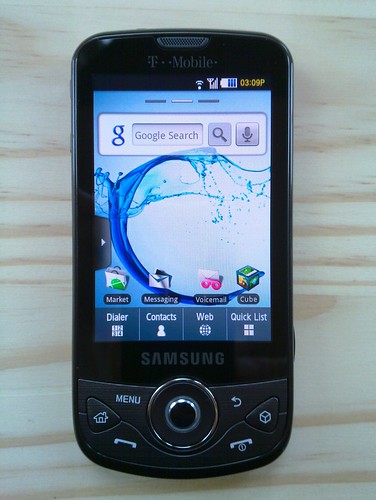
 Twitter is still growing strong, to my surprise – I thought it would have flattened by now as the new cool thing would show up for new media gurus to jump on. Also, the mainstream always lags behind pioneers by couple of years. That explains why Facebook is seeing biggest growth this year (2 years after it exploded in Toronto and about a year after I stopped using it on a daily basis), despite lack of any new groundbreaking features except for Facebook Connect. And while Facebook will continue to grow and be part of every household, like email, my jury on Twitter is still out , despite the fact that you cannot engage into conversation about Internet or media without the mention of it. I am still not convinced – I may be wrong but sometimes taking bold predictions and being dead wrong is also fun.
 Bing made a little scare in the Google world this year as it was, to everyone’s surprise, actually decent product. This immediately started talks about challenge to Google etc. I think they are still light years behind in terms of mind share and the know how (not so technologically, but in the knowledge you constantly acquire and evolve by serving 70% of worlds searches). But with acquisition of Yahoo search, Bing will gain more of the market share and the insight into the large volume search data, that will potentially help them improve the engine further. All of this is good, since it will force Google to innovate again (last year I compared them to IE6 – not having any serious competition, their search innovation almost stopped). This is particularly useful, since last year’s promising search technologies, like semantic search, failed to make any mayor impact.
 Chrome OS – I love Chrome Browser and use it all the time. And I use cloud service for everything good enough for my needs, not by comparing them feature by feature with desktop products. But I will move to the cloud when the services are ready, not when the browser/os limits my other choices. Linux is free and has a free browser that can access all features that Chrome OS can, yet consumers didnt flock to it, because they still need the polish/responsiveness offered by commercial OS-es – Win7 and Mac OSX. When web apps catch up, people will move to the cloud and the browser, with or without Chrome OS. Stripped down Linux limited with single browser will certainly not be the driver.
 Google Wave – something is wrong when many people desperately ask questions like “Tell me why this awesome new Google product is so awesome. I am obviously stupid, since I don’t get it’s usefulness and greatness and how it is making my life better”. Emperor’s new clothes, someone?
 Ask The Hoff is now available in the Android Market! It’s our first application for Android handsets (and our second app release in as many days, following on from Instant Turin), and is available to buy from today.